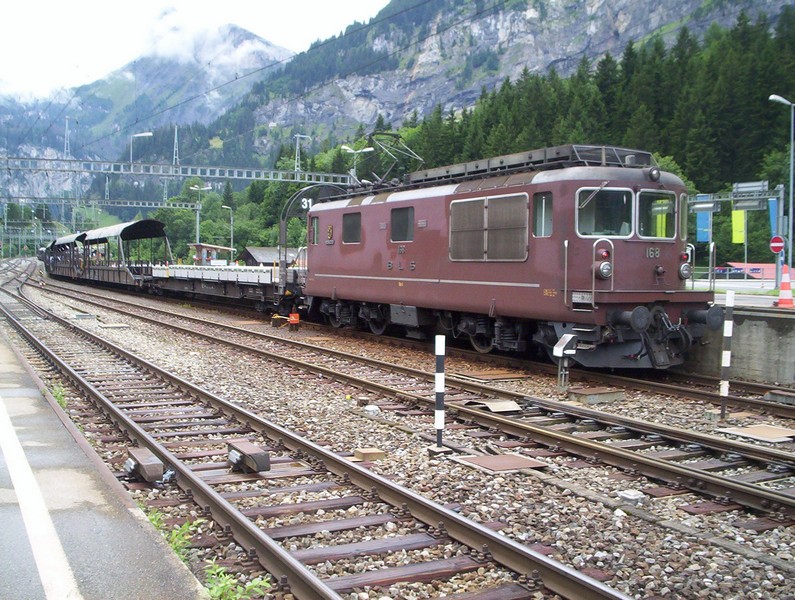
Cars through the Alps
Note : This article was written before the opening of the Lötschberg Base Tunnel which has considerably altered railway operations in this part fo Switzerland. The original text is reproduced here.
In a classic ‘prototype to model’ feature, Stephen Rabone gives food for thought.
“The Alps: mountains, snow, sun, trains and ……cars?”
Well, as railway enthusiasts we will all, no doubt, agree that the first four items on the list are why we enjoy this spectacular part of Europe but cars, surely not! However, cars and trains do go very much together in several places in the Alps.
Foremost of all locations is, of course, the Lötschberg main line between Kandersteg and Goppenstein in the Bernese Oberland. Here, the BLS operates a frequent shuttle service of car transporter trains through the Lötschberg tunnel, linking Canton Bern with Canton Valais. Formerly, some of these trains were also extended to run through the Simplon tunnel into Italy.
Elsewhere in Switzerland, car transporter trains can be found on the narrow-gauge RhB through the Vereina tunnel, linking Klosters with Engadine. Until the Gotthard road tunnel was completed, the SBB ran car transporter shuttles through the Gotthard rail tunnel. This service had to be temporarily re-instated in 2002 when the road tunnel was closed for some weeks following a serious fire. In Austria the ÖBB runs car ferry trains through the Tauern tunnel between Böckstein and Mallnitz.
In addition to these dedicated car transporter services there are also other locations where cars are ferried through tunnels on wagons attached to scheduled passenger services. This occurs, for instance, on the RhB’s Albula line and on some of ÖBB’s long distance expresses such as those across the Arlberg line.
For the model railway enthusiast, the incorporation of a car transporter shuttle service into a layout based in the Alps can add operational and visual interest. I hope to show how it is possible to do this within the constraints of a normal sized layout. I don’t intend to present this suggestion as a specific location but rather as an idea which the individual can tailor to his or her particular circumstances.
Car train to Goppenstein ready to leave from Kandersteg on 7th August 2005.
Choice of Scale
Visually, there is little doubt that a layout based on the Alps is probably best constructed in Z or N scale. The track work will not dominate the baseboard area and there will be greater potential for modelling the surrounding landscape. Even in a relatively small area it will be possible to more than hint at the existence of the mountains. Within the constraints of space that most of us labour under, HO scale is space hungry and, if using this larger scale, more reliance will have to be placed on back scenes and steep rock faces.
On the other hand, the variety of rolling stock in HO is greater than in the smaller scales. In the end the choice of scale will probably depend upon what it is the individual wants to achieve and his particular interests: if it is to capture the scenic splendour of the Alps then Z or N scale is more likely to be successful. However, if it is the trains running through the Alps that excite, then probably the greater choice of models in HO scale will be more important.
The Layout
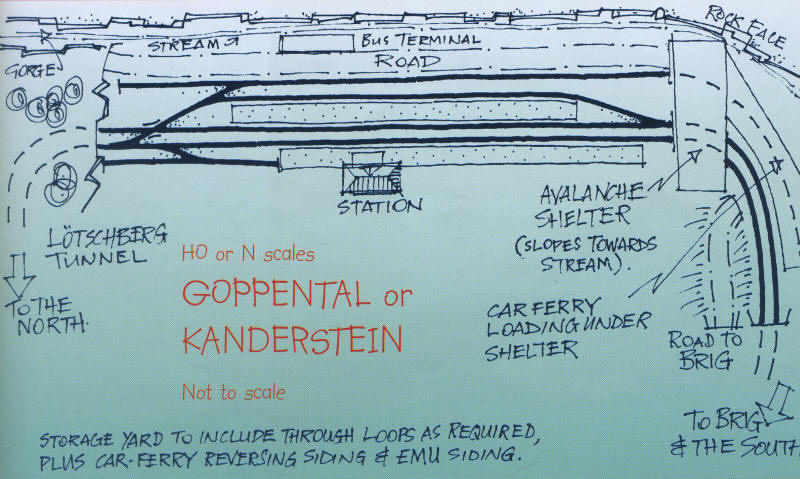
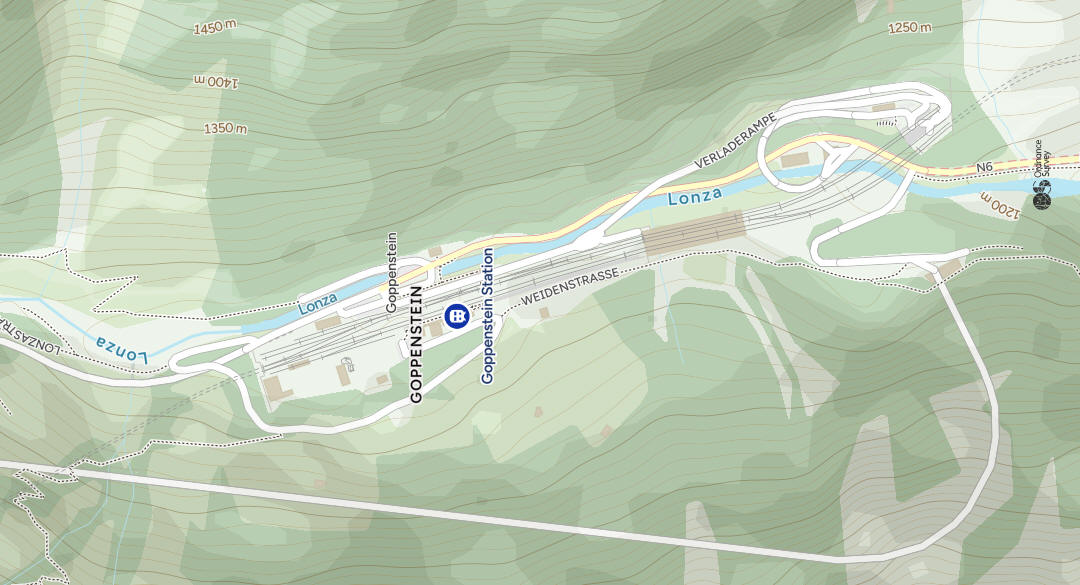
The plan above shows the current 2026 track layout.
I envisage the layout to be built as a through station fed by a series of loops hidden from view.
In designing the station plan I’ve looked at the features of both Kandersteg on the north ramp of the Lötschberg and Goppenstein at the head of the south ramp. Both stations are quite different in appearance. Kandersteg is a sprawling location with the station and car ferry terminal spread out across the high valley floor on the edge of the village, which is located to the east.
Goppenstein is much more space-constrained by the narrow valley and the station throat pointwork is hard up against the southern entrance of the Lötschberg tunnel. Part of the car ferry terminal is actually located inside the Meggibach avalanche shelter, a feature that is most useful to the modeller!
Naturally I’ve chosen Goppenstein as the basis of the layout in terms of physical appearance, but I suggest that some of the operational functions of Kandersteg could be transferred to Goppenstein to increase the interest when running trains. Whether you decide to use the name Goppenstein is a matter of individual choice; personally I would call the station either Kanderstein or Goppental.
As can be seen from the plan, the double track line emerges from the Lötschberg tunnel and immediately splits into a three platform station with a further line heading off to the car ferry transporter terminal which is located inside the avalanche shelter at the opposite end of the layout to the tunnel. The main line towards Brig disappears into this same shelter, whilst the road down into the Rhone valley can be seen dropping under the railway bridge. Freight facilities are minimal, just a siding with an open loading area and a small goods shed. Opposite the station is a small bus terminal (any self-respecting Swiss layout must have at least one yellow Post bus) for the bus route up the Lötschental (Lötschen valley). The main station buildings at both Kandersteg and Goppenstein are large substantial buildings built out of stone.
The mountainside at Goppenstein is ideal for our purposes, being extremely steep and covered in conifer trees or steep bare rock.
In the storage loop area of the layout the main requirements will be to fit in as many loops as possible to cater for the through main line trains. In addition one siding will be needed for the car transporter service for which pointwork will be needed to allow the train to enter the Lötschberg Tunnel on the left hand track and exit from the right hand track. Similarly another shorter dead end siding will be needed at the Brig end of the loops to cater for the Goppenstein to Brig local service.
The plan shows the layout as being built around four walls of a room or loft. I’ve not dimensioned the plan, as this will depend largely on the length of trains being run. In an ideal world I’d love to see 7 or so scale length coaches for the expresses and freights even longer than this. However, if space requirements are tight the layout would, I’m sure, look equally good with 1:100 coaches with only 5 coaches.
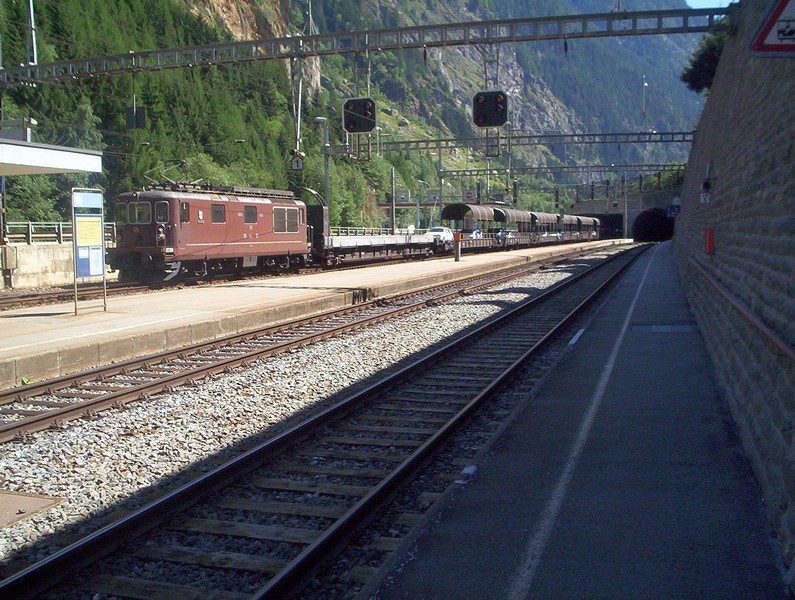
Car train to Kandersteg being loaded at Goppenstein on 9th August 2005. This is looking in the Brig direction.
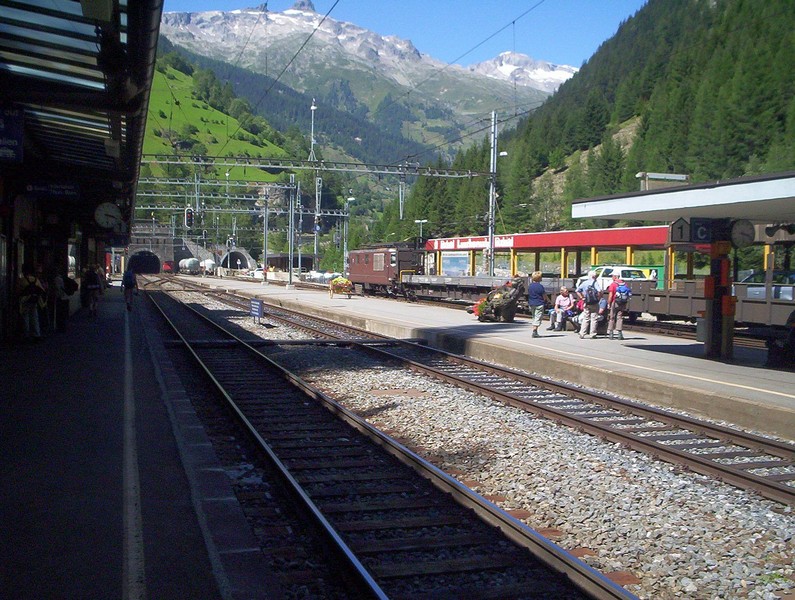
Lötschberg tunnel on 9th August 2005. Note the rail tunnel on the left and the smaller road tunnel on the right which is the main road into the Lötschental
Operation
The principal services over the Lötschberg main line are the hourly IC services provided by a mixture of BLS and SBB coaches and locomotives. In addition there are several EC trains running towards Italy and north to Germany, France and Belgium. These trains bring coaches from those countries, either in complete formations or individual though carriages. From observation made in summer 2000 and 2001 train locos were largely drawn from the ranks of the SBB 460s, with occasional SBB or BLS Re4/4’s and BLS 465s. Surprisingly, due to loco shortages SBB Ae6/6s have appeared on some expresses over the last year or so. In addition the “Cisalpin” tilting emus also appear on the route several times daily - I even saw one overtaking an IC train at Kandersteg, both trains heading in the same direction under reversible working signalling.
There are no local services at Kandersteg since BLS replaced stopping trains on the north ramp by buses, to increase the number of train paths during the rebuilding work necessary for operating the “Rollende Landstrasse” lorry transporter services. However, an electric multiple unit - usually one of BLS older 2 car emus - does shuttle back and forth between Goppenstein and Brig several times a day.
Freight traffic is quite heavy over the line, although not on the scale of the Gotthard. From what I have observed and photographic evidence in various publications, the usual mixture of block container, tanker, steel and mixed freight trains can be seen. BLS or SBB Re4/4s, SBB Re6/6s or 460s, often in multiple with each other, usually head these. A real speciality of the line is the daily “Tonerdezüge” or clay trains which run from Germany to Italy. These trains are so heavy that they are split into two sections at Frutigen, at the foot of the Lötschberg north ramp and worked up to Kandersteg in two sections. Here the two halves of the train are reassembled into one before heading south. Many freight trains may have banking locomotives, either at the end of the train, or cut into the train part way along its length, thus reducing coupling strain on the steep gradients.
A recent addition to freight traffic on the line is the daily “Rollende Landstrasse” lorry transporter trains from Freiburg to Novara in Italy. These operate about four times a day and are usually headed by BLS 465s. They make a colourful sight carrying lorries, with the drivers seated in a coach behind the loco.
Finally we come to the car ferry trains; the BLS runs these from early morning to late evening every day and at certain peak times through the night. Most trains carry cars but coaches and small vans or lorries are also conveyed on some services. Frequencies are usually at least hourly and often trains run every 10 to 15 minutes at really busy times. Most services are now provided by the long bogie wagons with covered roof. Normally all trains are powered by a BLS Re4/4, although at very busy times one of the older Ae4/4s may be pressed into service. Passengers stay seated in their car, or coach but all trains carry a coach at one end, which has a driving cab; the loco pushes the train in the Goppenstein direction and pulls it back towards Kandersteg.
The new Lötschberg base tunnel is, of course, under construction from Frutigen under the mountains and will emerge in the Rhone valley just west of Brig. This will have a significant effect on the traffic over the Lötschberg line, but I feel this is beyond the scope of this article so will say no more about it. However, modellers may wish to include operation of some of the construction trains that have run over the last few years carrying spoil from the tunnel workings.
Models
Finding the correct rolling stock in Z scale will prove difficult. No BLS and only a rather limited range of SBB models are available. If modelling the layout suggestion in Z, one will have to accept that the scenic potential is the main focus of the layout.
In N scale the situation is better, although patience may be required to obtain all the models required. Most of the BLS and SBB locomotives and coaches needed have been produced although the second hand market may have to be used to obtain all items needed. Hobbytrain produced the BLS car transporters but I believe is not currently available. However, it should be simple to modify or scratch build these vehicles.
In HO scale all the models needed can be sourced, although some items, especially the car transporters produced by Hag, may not always be available without obtaining second hand items.
Possible alternative ideas
Although this layout suggestion has concentrated on the Lötschberg route I can see no reason why the basic concept of the layout should not be relocated to a different railway company. Indeed the BLS is to transfer the Lötschberg to the SBB network and will concentrate its operations on suburban routes around Bern, so ultimately the Lötschberg will become more obviously SBB than at present.
I could also envisage this layout being operated using OBB stock, perhaps as an imaginary “Tauern” type operation, or even as a joint OBB/SBB cross-border route, with loco changing taking place in addition to the car transporter trains.